
Reviewed by the PopularGas Compliance Editorial Team – July 30, 2026. This is a procurement guide, not device, transport, regulatory or legal advice.
Short answer
Choose a CO2 cartridge OEM manufacturer by qualifying the exact product and the factory process, not by comparing price, a certificate logo or a nominal gram size alone. A defensible approval package includes a controlled drawing or reference sample, fill and gas-grade requirements, interface and device validation, inspection criteria, compliance scope, packaging, dangerous-goods review and change control.
For 8g-110g non-refillable cartridges, the same nominal fill can exist with different outside dimensions, neck or thread, sealing face, puncture geometry, materials, finishes and destination-market requirements. The approved specification revision should control the quotation, samples and bulk order.
Why supplier shortlists often fail
Many sourcing projects begin with a broad request such as “quote 12g CO2 cartridges” or “send your ISO and DOT certificates.” Those questions are too broad to prove fit. A supplier can answer quickly and still quote the wrong interface, gas grade, package or evidence scope.
A useful shortlist separates three questions: Can the supplier manufacture the required design? Can the supplier demonstrate control of the relevant process and tests? Can the proposed product and shipment meet the destination, equipment and documentation requirements? These questions need different evidence.
1. Classify the exact cartridge and application
Start with the intended device, use, nominal fill, water capacity, refillability, construction, sealing device and destination. Do not copy requirements from a large refillable cylinder onto a small non-refillable cartridge without checking scope.
ISO 11118:2025 covers non-refillable metallic gas cylinders within its stated limits and addresses materials, design, construction, inspection, manufacturing tests and sealing devices. Its existence does not make every cartridge “ISO certified.” Buyers should identify the exact standard, edition, product scope and evidence that applies.
- Device or equipment model and intended function
- Nominal CO2 fill and approved tolerance
- Reference water capacity and construction
- Outside diameter, length, neck or thread, seal and puncture geometry
- Gas grade or impurity limits required by the application
- Destination market, shipment mode, packaging and quantity
2. Treat a quality-system certificate as process evidence
ISO 9001 defines requirements for a quality management system. It is useful evidence that an organization has a documented management framework, but it does not by itself prove that a particular CO2 cartridge fits a device, has a stated gas purity, passed a particular test or is accepted for every market.
Ask for the certificate holder, manufacturing site, certification body, validity dates and certified scope. Then ask for product-level evidence separately. A buyer should never convert “the factory has ISO 9001” into “every product is ISO approved.”
3. Lock the engineering specification
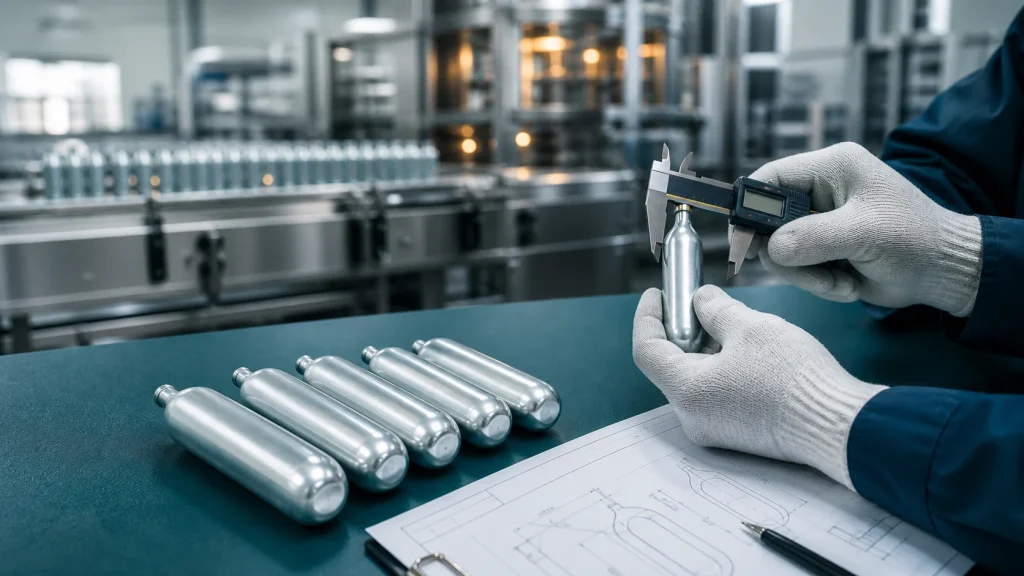
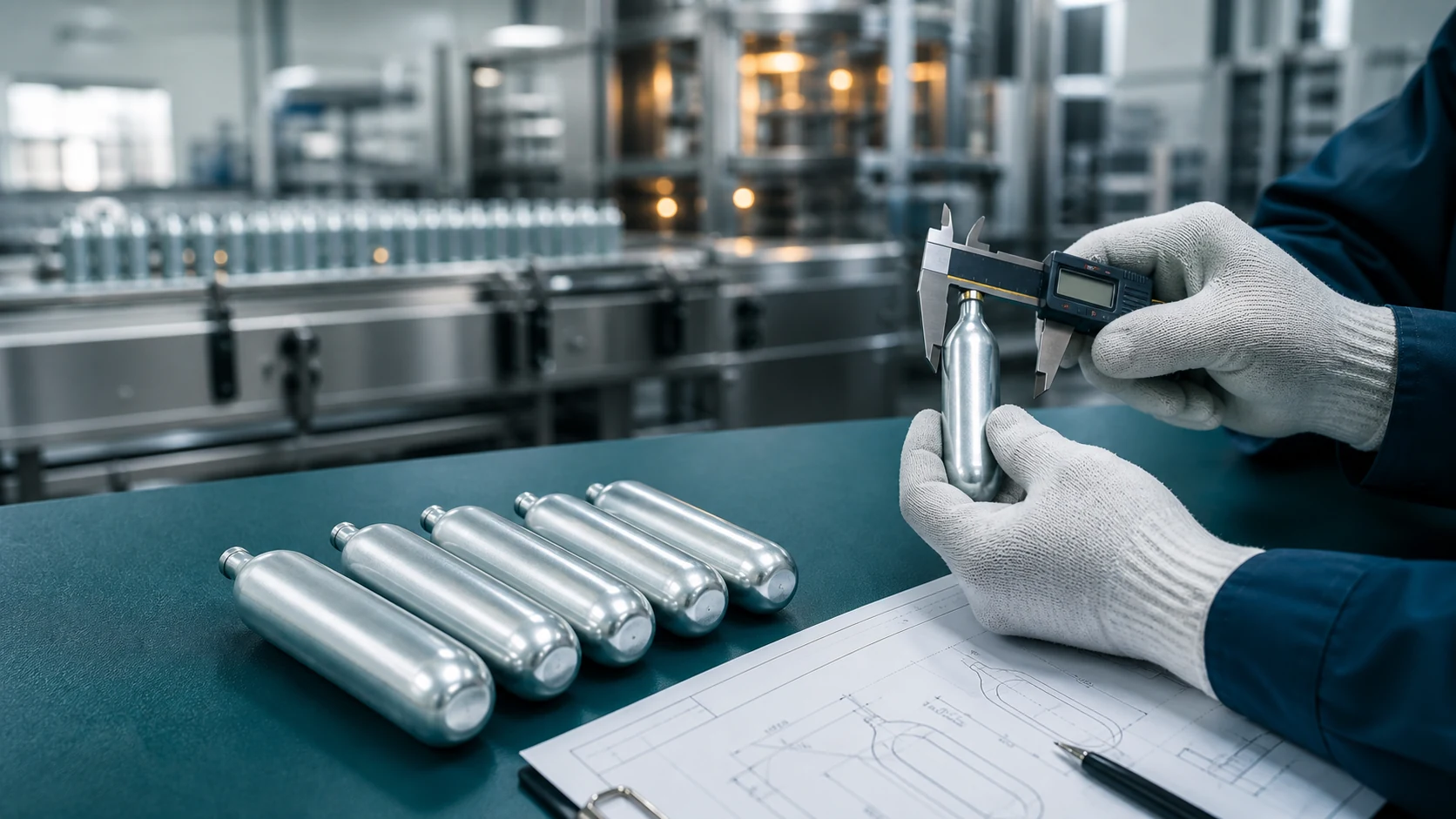
The drawing or approved reference sample should define what the supplier is expected to reproduce. A photograph, catalog label or nominal gram value is not enough. For a threaded design, record the complete thread designation and tolerances; for a non-threaded design, confirm the neck, seal and puncture profile.
Compatibility is a system result. The cartridge, valve or puncture mechanism, retainer, regulator, installed clearance, operating temperature and device acceptance criteria must be considered together. The final decision should come from validation in the intended equipment.
- Controlled drawing number and revision
- Critical-to-function dimensions and tolerances
- Material and finish
- Fill weight and allowed variation
- Interface, sealing and puncture requirements
- Marking, label and packaging specification
4. Approve samples before negotiating bulk production
A useful sample plan compares the proposed cartridge with the approved drawing or master sample and tests it in the intended device. The buyer and supplier should agree what constitutes a pass before samples are shipped.
Record sample quantity, batch identification, measurement method, device model, temperature range and acceptance result. If the sample changes after testing, issue a new revision and repeat the affected checks. Do not allow an unrecorded “minor change” to become the bulk-production standard.
5. Ask for product and batch evidence
The evidence package should match the risk and the contract. A brochure is marketing material; it is not a substitute for a controlled specification, inspection record or batch document. Ask the supplier to state which documents are available for the exact model and order.
| Evidence | What to verify | Typical scope |
|---|---|---|
| Drawing or product specification | Revision, dimensions, interface, fill, finish and acceptance limits | Exact model |
| Inspection or test record | Method, equipment, sampling plan, limits, results and date | Sample or lot |
| Gas-grade document | Composition or impurity limits, test method and issuer | Program or batch |
| Certificate or approval | Holder, issuer, standard, product/site scope, market and validity | Only the covered scope |
| SDS and transport information | Product identity, classification, packaging, mode and carrier acceptance | Actual product and shipment |
6. Separate CO2 vapour pressure from product test criteria
CO2 equilibrium vapour pressure changes strongly with temperature. It is not the same thing as a cartridge test pressure, burst-test criterion or the device’s regulated operating pressure. A single universal “working pressure” claim without temperature, method and scope is not a useful purchasing specification.
Ask the supplier to identify the applicable product test method and acceptance criteria. The equipment designer should separately confirm the valve, regulator, puncture, discharge, temperature and pressure requirements for the device.
7. Verify gas grade by application
“Food grade,” “medical grade,” “industrial grade” and a percentage purity claim are not interchangeable purchasing requirements. Define the actual gas composition or impurity limits, the applicable program or standard, the testing method, the batch evidence and the intended use.
For beverage equipment, also check equipment-maker requirements, food-contact obligations, cleaning and traceability expectations. Do not assume that a factory-wide purity statement covers every model or every batch.
8. Verify compliance scope for the destination
A certificate name or logo cannot replace a scope review. Ask which legal requirement, standard, approval or exception applies to the exact product and destination. Confirm the holder, manufacturing site, model or design, validity and marking obligations.
For the European Union, Directive 2010/35/EU establishes rules for transportable pressure equipment within its scope. For the United States, PHMSA administers the Hazardous Materials Regulations, including 49 CFR §173.306 on limited quantities of compressed gases. Applicability depends on the actual receptacle, gas, capacity, packaging, quantity, route and mode.
9. Qualify packaging and dangerous-goods shipment
A technically correct cartridge can still fail at shipment if the classification, packing method, marks, labels, quantity limits or carrier conditions are wrong. Review the actual consignment before production packaging is released.
Ask who prepares the shipment description and dangerous-goods documents, which transport mode is planned, how cartridges are restrained and protected, and whether the carrier has accepted the proposed configuration. Final regulatory and carrier acceptance should be confirmed by the responsible authority, carrier or qualified dangerous-goods professional.
Factory audit checklist
- Legal entity, manufacturing address and responsibility for the quoted product
- Incoming-material identification and supplier controls
- Drawing revision and change-control process
- Forming, cleaning, filling, sealing and finishing process controls
- Calibration status and measurement traceability
- Fill, leakage, dimensional and other required inspection records
- Nonconforming-product segregation and corrective-action records
- Batch identification and retained records
- Packaging approval and dangerous-goods handoff
- Customer complaint, field feedback and change-notification process
Evaluate production capacity without accepting a headline number
A daily or monthly capacity claim is meaningful only when the supplier explains the model mix, number of shifts, bottleneck process, normal utilization, maintenance plan and quality controls behind it. Capacity for a common unprinted cartridge may not equal capacity for a custom thread, finish or retail pack.
Ask for a capacity plan tied to the approved product and forecast. The plan should identify raw-material lead time, tooling or changeover, filling and inspection capacity, packaging labor, export booking and any customer-owned material. A cautious supplier that states assumptions is usually more useful than one that promises an unsupported number.
- Normal and peak output for the quoted model
- Bottleneck operation and planned utilization
- Tooling, line or shift assigned to the program
- Raw-material and packaging lead times
- Inspection, hold and release time
- Maintenance, holiday and contingency allowance
Compare price and lead time on equal scope
Two unit prices are not comparable when they cover different drawings, fill tolerances, gas grades, inspection plans, finishes, packages, shipment terms or documents. Require every supplier to quote the same controlled request and list deviations.
Lead time should be separated into engineering review, tooling or print preparation, sample approval, material preparation, production, inspection, packaging and shipment booking. The clock for bulk production should start only when the approval inputs are complete.
| Commercial item | Question to ask | Why it matters |
|---|---|---|
| Unit price | Which drawing, fill, finish, package and Incoterm are included? | Prevents a low quote built on missing scope |
| MOQ | Which component, print or packaging constraint sets the minimum? | Shows whether the minimum can change with packaging choices |
| Sample cost | Does it include tooling, printing, tests and freight? | Separates reusable setup from sample quantity |
| Lead time | What is the start event and which approval assumptions apply? | Avoids counting an unapproved design as production time |
| Payment | Which milestone releases tooling, materials and shipment? | Aligns cash flow with controlled approval gates |
Control changes after sample approval
The approved sample is not useful if the supplier can later change material, subcontractor, forming tool, sealing method, fill process, finish or packaging without notice. Define which changes require written notification, evidence review and requalification.
The purchase order should reference the drawing revision, approved sample or master, packaging revision and evidence list. If an alternate material or process is proposed, record the reason, affected characteristics and required re-test before acceptance.
- Material grade, thickness or supplier
- Tooling, line, site or subcontractor
- Sealing, filling, cleaning or inspection method
- Gas source or gas-grade specification
- Finish, lubricant, ink, label or packaging material
- Drawing, tolerance, marking or test-plan revision
Put the approval gates into the purchase contract
A sourcing checklist should become contract language. The quotation and purchase order should identify the controlled specification, sample status, evidence deliverables, packaging, shipment basis, change-notification rule and acceptance process. Otherwise, the technical work can be lost when the order moves from engineering to purchasing.
Define how nonconforming product will be contained, investigated and dispositioned. Also define record-retention expectations, access to replacement evidence and responsibility for buyer-supplied labels or packaging. These terms should be reviewed by the buyer’s legal, quality and dangerous-goods specialists where appropriate.
- Drawing and packaging revision
- Approved sample or first-article reference
- Inspection and batch-document deliverables
- Acceptance, rejection and corrective-action process
- Change-notification and requalification requirements
- Incoterm, shipment mode and dangerous-goods responsibilities
Supplier red flags
A red flag is a reason to ask for evidence, not an automatic rejection. Some suppliers use imprecise marketing language even when their factory controls are adequate. The qualification process should convert every important claim into a document, observation or controlled test.
If a supplier corrects an inaccurate claim, clarifies scope and provides traceable evidence, that response is itself useful information. If the supplier repeats an absolute promise and avoids the requested evidence, keep the supplier out of the approved shortlist.
- The supplier claims universal compatibility from gram size alone
- One purity percentage, certificate or approval is applied to every model
- Anonymous testimonials replace traceable product evidence
- The supplier refuses to identify drawing revisions or test methods
- Samples are not traceable to a batch or approved process
- The quote omits destination, packaging or dangerous-goods assumptions
- Material or process changes do not require customer notification
- Capacity, lead time or defect claims have no defined scope or record
RFQ information that produces a useful quotation
If any of these inputs are unknown, state that they are open items. A supplier should not hide uncertainty behind a quick unit price. The quotation should identify assumptions, exclusions, evidence availability and the approved specification on which the price is based.
- Application and device model
- Drawing, current cartridge or physical reference sample
- Nominal fill and gas requirement
- Interface, dimensions, finish and marking
- First order quantity and annual forecast
- Private-label packaging and barcode needs
- Destination, transport mode and delivery terms
- Required standards, certificates, test records and batch documents
- Sample quantity, acceptance criteria and approval schedule
A practical supplier scorecard
The weights can be changed for the project. Safety-device programs may assign more weight to evidence and validation; retail private-label programs may assign more weight to packaging and change control. The scorecard is most useful when every score links to a document or observation.
| Area | Weight | Pass signal |
|---|---|---|
| Engineering match | 25% | Controlled drawing/sample and device-validation plan |
| Process and quality control | 20% | Traceable controls, calibrated inspection and records |
| Product evidence | 20% | Model- or batch-specific documents with clear scope |
| Compliance and transport | 15% | Destination and shipment review without blanket claims |
| Commercial execution | 10% | Clear assumptions, packaging, forecast and change control |
| Communication | 10% | Questions are resolved in writing before approval |
How PopularGas reviews an OEM program
PopularGas begins with the equipment, drawing or reference sample and then confirms the applicable cartridge specification. The review covers the model, interface, nominal fill, gas requirement, finish, packaging, destination and requested evidence. Samples are approved against an agreed revision before bulk production planning.
This process does not mean one cartridge is universal or that one certificate covers every model and country. The available documents and tests are confirmed for the selected program.
Frequently asked questions
What is the minimum order quantity for private-label CO2 cartridges?
MOQ depends on the cartridge model, finish, printing, retail package, test and document scope. Ask for a quotation against the approved specification and packaging rather than treating one number as universal.
Is a factory’s ISO 9001 certificate enough?
No. It is quality-management-system evidence. You still need product-level specifications, sample approval, inspection criteria, evidence scope and destination/shipment review.
Can a catalog size prove device compatibility?
No. Confirm the complete geometry, interface, seal, puncture, installed clearance and functional performance in the intended device.
Should buyers request DOT, TPED or CE documents?
Request the exact legal or standard basis that applies to the product, destination and transport scenario. Do not use the labels as interchangeable marketing terms.
When should bulk production start?
After the drawing or master sample, test plan, packaging, evidence list and commercial assumptions are approved in a controlled revision.
Primary sources and related PopularGas guides
- ISO 11118:2025 – Non-refillable metallic gas cylinders
- ISO 9001:2015 – Quality management systems
- PHMSA – 49 CFR §173.306
- EUR-Lex – Directive 2010/35/EU
- PopularGas Quality and Compliance Evidence Hub
- PopularGas CO2 Cartridge Specification Center
- PopularGas Sample Matching Guide
- PopularGas YouTube channel
Turn your requirement into a controlled OEM specification
and include the device, drawing or sample, destination, first order, annual forecast, packaging and evidence list.


